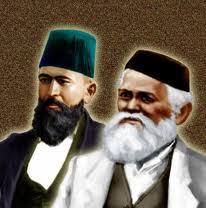
Bahauddinbay Musabay (1852 – 1929 CE)
Husayinbay Musabay (1844 – 1926 CE)
Bahauddin Musabay was born in 1852 in Kashgar into an eminent, deeply religious, and visionary merchant family. His father, Musabay Hajim, harbored a lifelong ambition to awaken and modernize his people, educating his sons with profound devotion to religious ethics, public service, and societal advancement.
When Musabay Hajim passed away in 1893, he left behind an extensive trans-Eurasian trading enterprise spanning Kashgar, Tashkent, Samarkand, Andijan, Osh, Moscow, and St. Petersburg. Following his demise, his two eldest sons—Husayinbay and Bahauddinbay—assumed leadership of the family enterprise, expanding it into an international commercial network and channeling their substantial fortunes into social reform, modern education, and technological infrastructure.
The Musabay brothers were the pioneers who brought modern Western industrial technology to Eastern Turkistan:
- The Artush Mechanized Leather Factory: They imported state-of-the-art steam engines, tanning machinery, and processing equipment from Germany and Sweden, erecting Central Asia’s premier modern leather manufacturing complex in Artush.
- Textile & Agriculture: They developed mechanized spinning workshops, enabling local farmers and pastoralists to export processed goods to European and Russian markets.
- Public Works: They engineered regional irrigation systems, canals, and highways connecting Kashgar and Artush, financing civic works entirely out of pocket.
Convinced that national liberation and social dignity were unattainable without modern education, the Musabay brothers launched the historic Jadid (New-Method) schooling revolution:
- The Iksaq School (1885): In their ancestral village of Iksaq in Artush, they established the first modern Uyghur school equipped with desks, blackboards, geography maps, unified textbooks, and structured timetables combining modern sciences with Islamic studies.
- International Faculty: They recruited veteran educators from Istanbul (Ottoman Empire), Tatarstan, and Kazan (such as the famed educator Ahmet Kemal Bey), providing them with handsome salaries and modern housing.
- Free Education for All: They funded tuition, dormitories, dining, textbooks, and clothing for thousands of impoverished students and orphans.
Alongside primary schools, the brothers invested heavily in higher Islamic learning:
- Khanliq Madrasah (Kashgar): In 1911, they financed the complete restoration of the grand 16th-century Khanliq Madrasah in central Kashgar, converting it into a premier university of higher Islamic scholarship rivaling the famous madrasahs of Bukhara.
- Vangliq Madrasah (“Dar al-Mu’allimin”): Directly adjacent, they refurbished the ancient Vangliq Madrasah, establishing the region’s first modern teacher training college (Dar al-Mu’allimin), which supplied qualified instructors across the Tarim Basin.
- International Scholarships: The brothers financed dozens of talented Uyghur youth to study medicine, engineering, law, military science, and pedagogy in Istanbul, Berlin, Moscow, St. Petersburg, and Cairo.
- Ties with the Ottoman Caliphate: Bahauddinbay traveled to Istanbul, where he held formal audiences with Ottoman ministers and intellectuals, describing the conditions of Muslims in Central Asia and forging lasting educational links (documented in Isa Yusuf Alptekin’s Esir Doğu Türkistan İçin)1.
- Husayinbay passed away in Kashgar in 1345 AH (1926 CE).
- Bahauddinbay passed away peacefully in 1348 AH (1929 CE), having witnessed the awakening of an entire generation through his schools.
Following their deaths, Chinese warlord authorities systematically persecuted their descendants, seizing assets and destroying institutional networks. Bahauddinbay’s grandson, civil engineer Sabir Muhammad Zohuriddin, migrated with his mother to Mecca in 1930, where the family found refuge and continued their scholarly life.
The Musabay brothers remain shining emblems of how visionary entrepreneurship, steadfast faith, and selfless philanthropy can transform the destiny of an entire nation.
- Muhammad Qasim Amin al-Turkistani: Al-I’lam bi-Ba’d Rajalat Turkistan (“Biographies of Certain Prominent Figures of Turkistan”).
- Sajiya Islamic Research Center (Uyghur translation by Bilimyar, Article ID: 2497).
- Isa Yusuf Alptekin: Esir Doğu Türkistan İçin (“For Captive Eastern Turkistan”), Istanbul, pp. 116–177.